


Love. It’s one of the most familiar and yet misunderstood words in any language. We use it casually and often: “I love this song,” “I love my family,” “I love my life.” But what if love—like every value—is not a fixed emotion or singular idea, but a concept we’re constantly relearning?
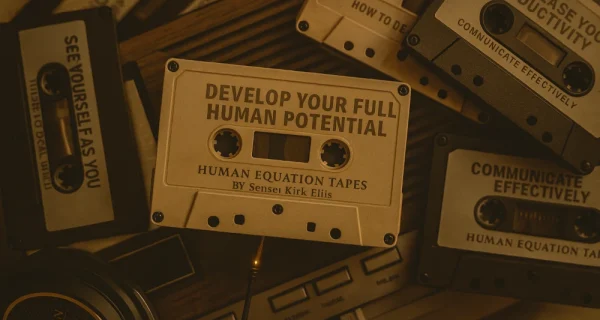
In Tape 1 of The Human Equation, we’re invited to explore love not as a static feeling, but as a value concept—one that evolves, matures, and deepens over the course of a lifetime.
Let’s explore how this concept unfolds, and what it means to truly *earn* the right to love with insight, respect, and truth.
The Evolving Definition of Love
“Everyone is constantly changing and relearning each value concept…”
We often think of our values as steady, but they’re constantly shaped by our experiences. Love is a prime example. As children, our understanding of love begins as simple affection or dependency. As we grow, it branches into admiration, passion, care, and eventually—if we continue to learn—something even deeper: *selfless, conscious connection.*
The tape walks us through this natural evolution:
– A young child loves himself, then his mother.
– By age 7 or 8, he loves candy or television.
– At 14, he loves hobbies or has romantic crushes.
– On graduation night, love includes nostalgia, joy, and sadness all at once.
This progression reveals that love is not one thing—it’s a spectrum, and we’re always moving along it.
“Love is always expanding and takes on a new and different meaning…”
But here’s the key:
The quality of love depends on how we associate it with life and reality.
Does love lead us toward connection, or control?
Toward understanding, or expectation?
Toward empathy, or possession?
That’s where our inner development comes in.
Love Must Be Learned, and Relearned—and Elevated
“Love, like all of the other values, has many dimensions, and to understand love better we must seek to relearn it and mold it in a more classical way…”
At a lower level of consciousness, love is little more than desire—a yearning to possess or be validated. At higher levels, love becomes an expression of honor, truth, sacrifice, and respect.
To reach this higher form of love, we have to mold it, practice it, and ultimately *become* it.
Just like you wouldn’t expect to play Beethoven your first time at the piano, you cannot expect to love well without practice and awareness.
“Love is ethically ineffective until it has been properly molded.”
The Rewards of Living Your Values
Positive values like generosity, kindness, and loyalty often seem noble in theory—but distant in daily life. We may admire them, but until we use and embody them, their full power stays out of reach.
“Before anyone can feel and see the power and effectiveness of tolerance, generosity, respect, and trust, they must use and become these concepts.”
This is the heart of value-based living:
– You don’t understand generosity until you *practice* it.
– You don’t understand empathy until you *become* it.
– You don’t truly experience love until you *live* it.
And once you do?
“Those who use and expand positive values will gradually get to observe the morality and unity of things… They will be protected by the wisdom of their own actions.”
You begin to act wisely because your being has changed. Your values are not just ideas—they’re embodied. And when that happens, you gain:
– Peace of mind
– Better health
– Inspiration
– Resilience
– Clarity
This is the hidden benefit of becoming a more value-aligned person: you begin to see life differently. You see with insight. You live with deeper appreciation. And your emotional life becomes grounded, powerful, and joyful.
Earning the Right to Enjoy Higher Emotions
“Being truthful, ethical, tolerant, and honorable might seem dull and boring but these concepts are extremely exciting and fun.”
There’s a beautiful paradox here: values like ethics, honesty, and kindness are often seen as restrictive or old-fashioned. But when lived from the inside out, they produce emotional states—like peace, bliss, and joy—that are richer than any quick fix or temporary thrill.
“It’s like playing the piano, painting, or meditation—it takes time and practice to really be able to enjoy these things.”
You don’t instantly enjoy classical music. It requires patience and presence.
The same is true for ethical joy—the deep sense of fulfillment that comes from doing what’s right, not because you have to, but because it feels aligned with who you are becoming.
“You have to earn the ability to enjoy playing the piano. You have to earn the right to enjoy ethical behavior.”
This idea is revolutionary in a culture that expects instant gratification. Real joy isn’t free—it’s cultivated.
“You have to earn the right to enjoy the emotional feelings that are cultivated with tolerance, respect, kindness, and empathy.”
And when you do, the reward is greater than pleasure—it’s meaning.
The Highest Reward: Seeing the Unity of Life
“You have to earn the right to see the unity of things, to really love life, and see with insight… and this right is earned by using and expanding positive values.”
This is where all the pieces come together.
When you live with integrity, when your love matures into respect and service, when your actions align with timeless values—you begin to see reality differently.
You stop fighting life, and start flowing with it.
You stop judging others, and begin understanding them.
You stop craving more, and begin appreciating what already is.
This is not passivity. It’s the *deepest power available to a human being*: a life lived in harmony with the positive aspects of your human nature.
Final Reflection: Relearn, Refine, Rise
Your concept of love is not finished. It’s evolving—just like you are.
You can choose today to:
– Revisit your current values
– Practice the ones that uplift you
– Expand your capacity to feel and express love
– Earn the emotional richness that comes with inner harmony
Because love is not a static trait. It’s a living value that grows as you grow.
And the more you grow in love, the more you rise in life.
Photo Credit: https://www.pexels.com/@nappy/


Related Post

-
Personal Growth,Values & Your Human Equation




© 2026 Sonic Discovery, LLC – The Human Equation Tapes
Privacy | Terms | Disclaimer | Return Policy
5020 Clark Rd STE 109 Sarasota, FL 34233